
Breathing Technique for Stress Management
Your breathing is a constant companion that you can use as a compass to stabilize your nervous system and improve your general well-being. Since the dawn of time, our breath has been a part of who we are and has been a tool for self-control. In fact it is the only human act that can be done both consciously and unconsciously and doing so the right way can directly impact your nervous system.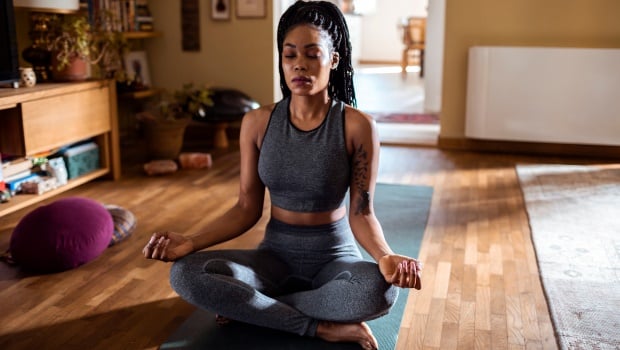
Most adults tend to only breathe deeply enough to fill their chests, which is referred to as shallow breathing. Shallow breathing makes your body experience needless stress and discomfort. When your breathing is shallow, you’re not getting enough oxygen down into the bottom part of the lungs, which is where many of the small blood vessels that deliver oxygen to your cells live. Healthy cells need proper amounts of oxygen.
I know what you’re asking yourself, “how can I begin to breathe better?” But before you can use your breath as a tool for self-control and stress reduction you must first become aware of your breath. Not in the sense of “i am breathing” but in the sense of “I Am Breathing”. When you can consciously focus on your breath you can begin to activate your parasympathetic nervous system, which houses the rest and digest response vs the sympathetic nervous system, which houses the fight or flight response. I do want to make it clear both responses are needed but sometimes life’s hassles can throw this delicate ecosystem off.
Breath awareness techniques or breathing exercises is your first step to breathing right. These breathing exercises can be done with yoga or meditation practice or as a standalone tool for stress management. integrating a breathing exercise in your daily routine can reduce tension brought on by stress from the day's events. Harvard Medical School specialists claim that “Your respiration quickens when you're stressed. Breathing gives you more control over your mental state to intentionally slow your breathing." We can safely move through these emotions and lead authentic, free lives if we intentionally address our uncomfortable feelings head-on. Other studies have shown that mindfulness techniques, such as breathing exercises, can help people feel less stressed in normal situations, such as experiencing test anxiety all the way to calming panic attacks. Practical stress-reduction approaches, such as breathing exercises, can sometimes be a helpful stress-management techniques for reducing stress in real-world situations.
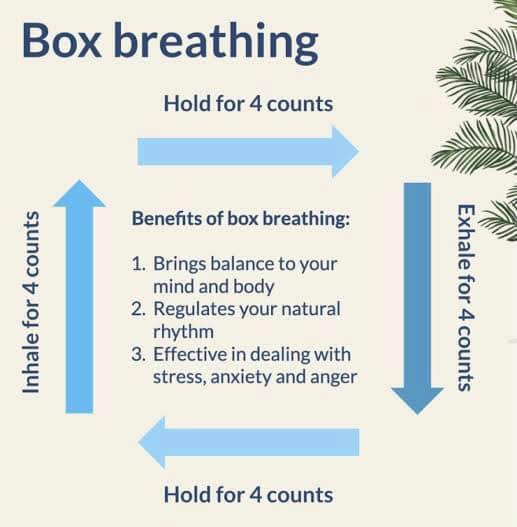
Box breathing, also known as the four-part breath helps to calm your parasympathetic nervous system, decrease stress in the body, and center yourself in the present moment. Box breathing involves exhaling to a count of four, holding your lungs empty for a four-count, inhaling to a count of four, and holding air in your lungs for a count of four before exhaling and beginning the pattern again.
Tips
. Try different times throughout your day
. Include your family and friends
. It’s okay if your mind wonders while counting
. Discontinue if this breathing exercise causes you any adverse reactions
Thank you and be sure to follow us on all socials @theemochayoga and subscribe to our youtube channel for free guided meditations!
Refference
Hypoxemia: Causes, symptoms, diagnosis & treatment. Cleveland Clinic. (2025, August 25). https://my.clevelandclinic.org/health/diseases/17727-hypoxemia
University, H. (2021, March 20). Overcoming fear and worry test. Harvard Health. https://www.health.harvard.edu/promotions/harvard-health-publications/overcoming-fear-and-worry-test?utm_source=delivra&utm_medium=email&utm_campaign=OG20221226-Fear&utm_id=4583994&dlv-emuid=c3db6616-3340-4066-86a4-594cccc97e99&dlv-mlid=4583994